Three Hours of Sentencing: A Chinese Defense Lawyer in the Southern District of New York
About this article: This article was first published in Chinese on August 10, 2026 (read the original). This English version has been adapted for international readers, with added comparisons to Chinese criminal procedure.
On a recent trip to New York, I set aside time to sit in on court proceedings. I practice criminal defense in China, and I wanted to see how the American rules I had studied work in a real courtroom.
I watched a sentencing hearing in the U.S. District Court for the Southern District of New York (SDNY). Two defendants had already pleaded guilty. For about three hours, their lawyers, the prosecutor, the defendants themselves and the judge addressed one question: what sentence each of them should receive.
What follows is what I saw, and how it compares with sentencing in Chinese criminal cases.
Getting into the courthouse
The hearing took place at the Daniel Patrick Moynihan United States Courthouse, 500 Pearl Street, in lower Manhattan, not far from the Brooklyn Bridge. SDNY handles a large share of the country's major financial, securities and transnational criminal cases.
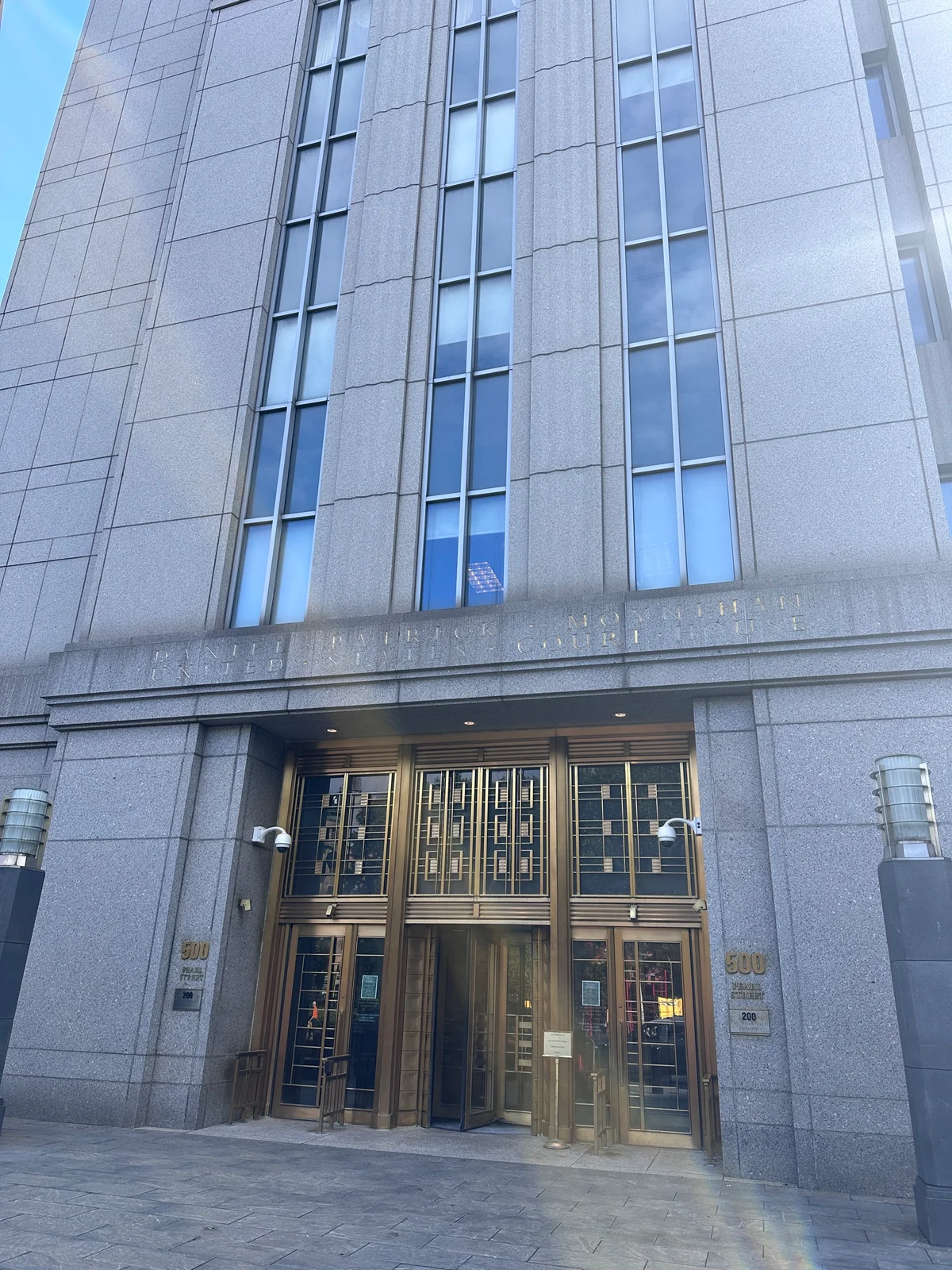
Photo: The Daniel Patrick Moynihan United States Courthouse, 500 Pearl Street
Members of the public pass through security and may not bring phones, cameras or smartwatches into the building; small devices can be checked at the entrance. Paper and pen are allowed. No photography or recording is permitted in the courtroom.
The court publishes a daily Civil & Criminal Proceedings Calendar listing each case name, docket number, type of proceeding, judge, courtroom and time. Docket numbers containing "CV" are civil cases and those containing "CR" are criminal cases. Since phones stay outside, it helps to print the calendar or copy down the cases you want to see.
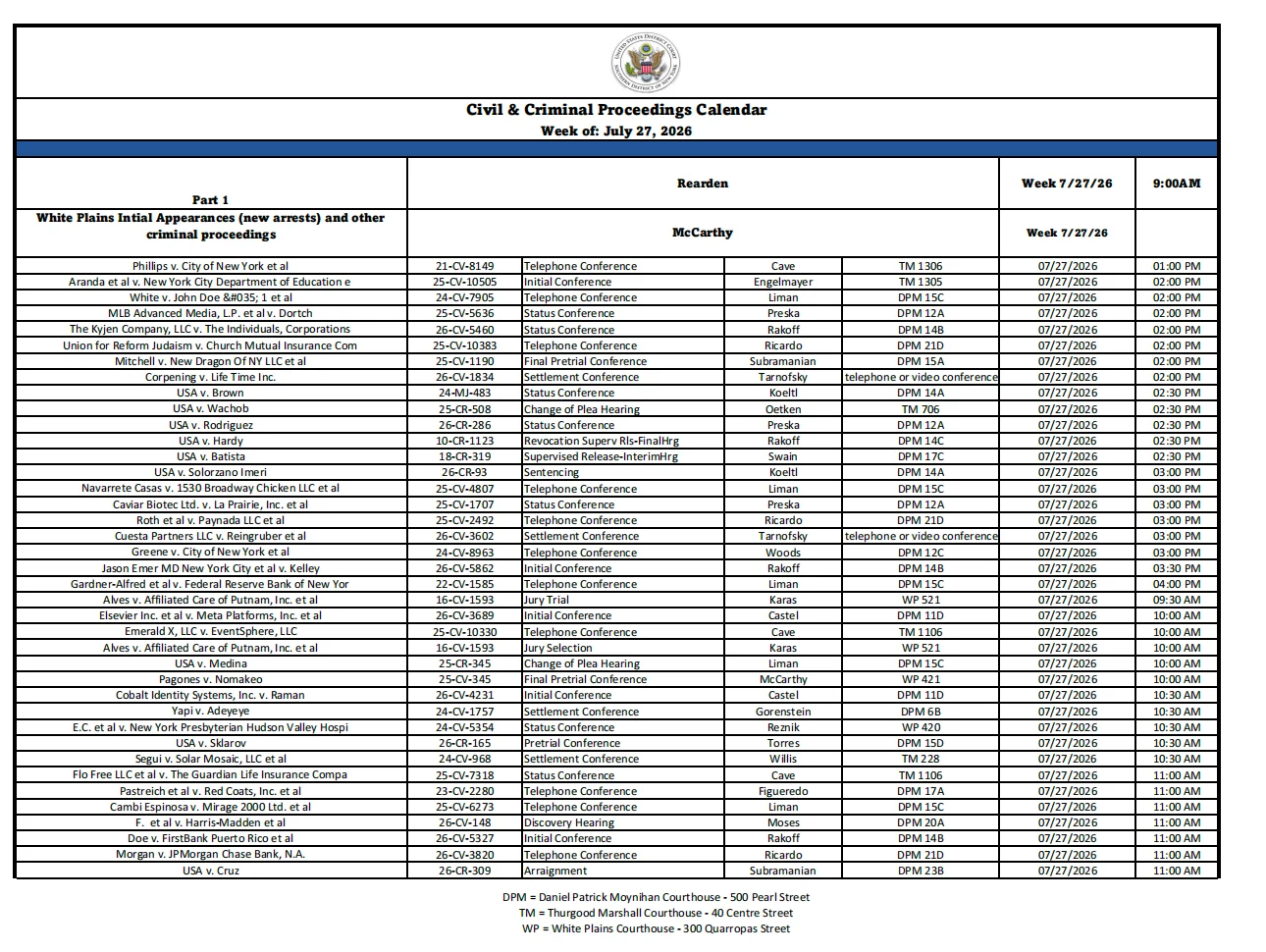
Screenshot: SDNY Civil & Criminal Proceedings Calendar
Inside, screens show which proceedings are under way, but the most useful step was to ask at the Clerk's Office, which handles filings, records and public inquiries. The clerk who helped me was friendly. There were no jury trials that morning, she said, but a criminal sentencing would start in half an hour, and she told me where to go.
The public gallery filled up before the hearing. Some people appeared to be the defendants' family and friends; others, like me, were simply observers. No one asked who I was or why I was there.
The case
The case involved a large-scale bank fraud and wire fraud scheme. According to the indictment, which I looked up afterward, several defendants were charged with conspiracy to commit wire fraud and bank fraud and related offenses, through a years-long scheme involving government checks: they opened bank accounts using shell companies and stolen or fictitious identities, and deposited stolen or fraudulently obtained checks, some of them involving COVID-19 relief funds. The government alleged at the charging stage that the scheme sought about $80 million and actually deposited checks worth about $50 million.
The hearing concerned two of the defendants, whom I will call Defendant One and Defendant Two. Both had pleaded guilty to Count One (conspiracy to commit wire fraud and bank fraud), so the only question that day was the sentence.
In federal cases, the judge, not the jury, decides the sentence. The judge must first correctly calculate the range under the Federal Sentencing Guidelines and then weigh the factors in 18 U.S.C. § 3553(a), including the nature of the offense, the defendant's history and characteristics, deterrence, protection of the public and the need to avoid unwarranted disparities. The Guidelines are advisory; the judge does not have to sentence within the range.
How this differs in China: Chinese courts do not hold a separate sentencing hearing weeks after conviction. Guilt and sentence are argued in the same trial, which includes a dedicated "sentencing debate," and the court usually delivers a written judgment later covering both. When a defendant accepts the charges under China's "admission of guilt and acceptance of punishment" procedure (认罪认罚, broadly comparable to a plea agreement), the procuratorate (the state prosecution authority) makes a sentencing recommendation, which the court generally adopts.
Before argument: settling the facts
The judge began with procedural confirmations. He listed the sentencing materials he had received and asked both sides whether anything was missing. He then asked the defense whether it objected to any facts or to the Guidelines calculation. The government corrected one figure; the judge asked the defense whether it objected to the correction, and it did not.
Federal sentencing rests on the Presentence Investigation Report (PSR), prepared by the U.S. Probation Office. It covers the offense, the defendant's personal and family background, criminal history, the Guidelines calculation and other relevant information. Both sides can object to it, and at sentencing the judge must identify which facts are settled and which remain to be decided.
For a defense lawyer, this means the sentencing hearing is not where the sentencing argument begins. Much of the work has already been done through PSR objections, the sentencing memorandum, letters of support and other written submissions. The oral argument is the final presentation of that work.
China has no general equivalent of the PSR. When a suspended sentence is being considered, a community corrections agency may be asked to assess whether the defendant can be supervised in the community, but that is much narrower than a full presentence report.
Defendant One's lawyer: look at the whole person
Defendant One had worked inside a bank. His lawyer spoke for about half an hour, emphasizing that the client had no prior record and should not be defined by one offense; describing his family responsibilities and his prospects of rebuilding his life, and distinguishing his role from that of his co-defendants. Counsel also cited other cases in which, counsel argued, defendants with more serious conduct had not received heavier sentences. Many relatives sat in the gallery, and at one point the lawyer gestured toward them: family support was part of the picture the defense presented.
The judge interrupted once, to ask exactly what position the defendant had held at the bank, because the materials described it differently. The lawyer checked with his client and answered.
Defendant One speaks
The judge then invited Defendant One to speak, telling him that this was his opportunity to say anything he wished to the court. This is allocution: under Rule 32 of the Federal Rules of Criminal Procedure, the court must allow the defendant to speak and present any information in mitigation before imposing sentence.
It serves a purpose similar to the defendant's "final statement" (最后陈述) at the end of a Chinese criminal trial, though the two are not identical.
Defendant One read a prepared statement. He expressed remorse, thanked the government and the court for helping him recognize his wrongdoing, and apologized to those he had harmed and to his family. He said he had let his family down, and that he would keep learning, start over and not break the law again.
Defendant Two: can a hard life be a reason for leniency?
Defendant Two's lawyer leaned even further into the personal story. Counsel spent a long time on his upbringing: poverty, abuse in childhood, a mother struggling to raise him, not speaking English as a young child, and the setbacks that followed.
This lawyer, too, cited other cases in which defendants with prior records and no less serious conduct had received lighter sentences, arguing for consistency. Counsel repeatedly urged the judge not to be bound mechanically by the Guidelines range, because each person is different and the court must judge the individual in front of it.
The lawyer thanked the judge at the end, and the judge thanked counsel in return. Defendant Two then spoke, again mainly about his background and early life.
The government: back to the offense
Where the defense lawyers spent most of their time on the defendants as people, the Assistant U.S. Attorney focused on conduct, role and harm.
On Defendant One, the prosecutor argued that his role was critical because the scheme depended on him. As a bank insider, he had access to internal systems and customer and account information, knew how deposits worked and how the bank operated, and coached others, including on how to use a hotline intended only for bank staff. He abused that access, knew which accounts were involved and helped with deposits and withdrawals. The government attributed $28 million in loss to him. This was not an isolated event but a scheme that ran for years; he was an organizer and leader, the gateway through which the others succeeded. The Guidelines sentence, the prosecutor argued, was appropriate and would serve the purposes of sentencing.
On Defendant Two, the government was brief. His personal history, it argued, should not diminish the offense. Even setting the Guidelines aside, this was a serious fraud: hard to detect, involving stolen personal information, government funds and identities.
The contrast was clear in the room. The defense tried to pull the camera back from the crime to show the whole person; the government kept pulling it back to what the defendant had done and the risk it created. Both stories ended up in front of the judge.
The judge's reasons: 84 months and 96 months
The judge then gave detailed oral reasons, about half an hour for each defendant.
He began by stressing that federal sentencing is an individual judgment. A shared crime does not mean a shared sentence: each person's role, history and record may differ. What the law forbids is unwarranted disparity, not all disparity.
He said he had considered the facts, the lawyers' arguments and the written submissions, and that he was not required to follow the Guidelines mechanically. At the same time, he returned repeatedly to the nature of the offense: it targeted government programs, was concealed, and undermined public trust.
On Defendant One, the judge noted that he was educated and could have earned a living lawfully, and took into account his family and his lack of a criminal record. Describing his role, the judge twice used the word "indispensable": his position inside the bank made him an essential link in the conspiracy.
He sentenced Defendant One to 84 months' imprisonment, followed by five years of supervised release, together with forfeiture.
Supervised release is neither probation nor parole in the traditional sense. It is a period after release from prison during which the person is supervised by the federal probation system and must comply with court-ordered conditions. China has no direct equivalent.
On Defendant Two, the judge again gave detailed reasons. Unfortunately, my pen ran out of ink at this point, so my notes are brief. The judge acknowledged the difficult upbringing the defense had described, and weighed it against the defendant's role in the conspiracy and his prior record.
He sentenced Defendant Two to 96 months' imprisonment, followed by five years of supervised release, with corresponding financial consequences.
After the sentence: objections, conditions and self-surrender
The hearing did not end with the sentence. The judge asked defense counsel whether they had any objection to the reasons he had just given; they did not.
He then confirmed that neither side objected to the supervised release conditions in the PSR, and read out several of them: not to commit any federal, state or local crime; not to unlawfully possess or use controlled substances; to submit to drug testing and DNA collection; and to take part in approved treatment programs.
Neither defendant was taken into custody in the courtroom. The judge directed each of them to self-surrender to the Bureau of Prisons by a set date and time. In federal cases, a prison sentence does not necessarily mean being taken into custody on the day of sentencing.
Three observations
A guilty plea is not the end of the defense. This was a guilty-plea case with the main facts and the Guidelines calculation largely undisputed. Even so, each defense lawyer made a substantial oral argument, on top of PSR objections, a sentencing memorandum and other written materials, and the hearing ran about three hours. Criminal defense is not only about guilt or innocence. Turning an abstract "defendant" back into a particular person is a central part of it. The same is true in China, where much of the most consequential defense work happens at the sentencing stage.
The judge's reasons are part of the hearing. The judge did not simply announce "84 months" and "96 months." He spent a long time explaining what he had considered, why certain factors mattered, and why two co-defendants could receive different sentences. For the people involved, the outcome matters most, but knowing why it is the outcome is part of what makes it acceptable.
Professional respect was visible throughout. Each defense lawyer spoke for about half an hour; the judge responded to their points in his reasoning and thanked them when they finished. While the judge gave his reasons, the courtroom was almost silent; at times I could hear people breathing in the gallery. Everyone had a different role, but the differences did not get in the way of mutual professional respect.
Note: This account is based on my notes from a public hearing. Statements by the lawyers, the prosecutor, the defendants and the judge are summarized, not quoted verbatim. The official court record governs the facts of the case, the sentences imposed and what was said in court. These are personal observations of one hearing, not an assessment of U.S. federal criminal practice as a whole.
This article is for general information only and is not legal advice on any specific matter. To discuss your matter, please contact the author.
Want to talk through your situation?
If the matter is urgent, call or message on WeChat. You can also send an enquiry describing where the matter is, its current stage and your main question.